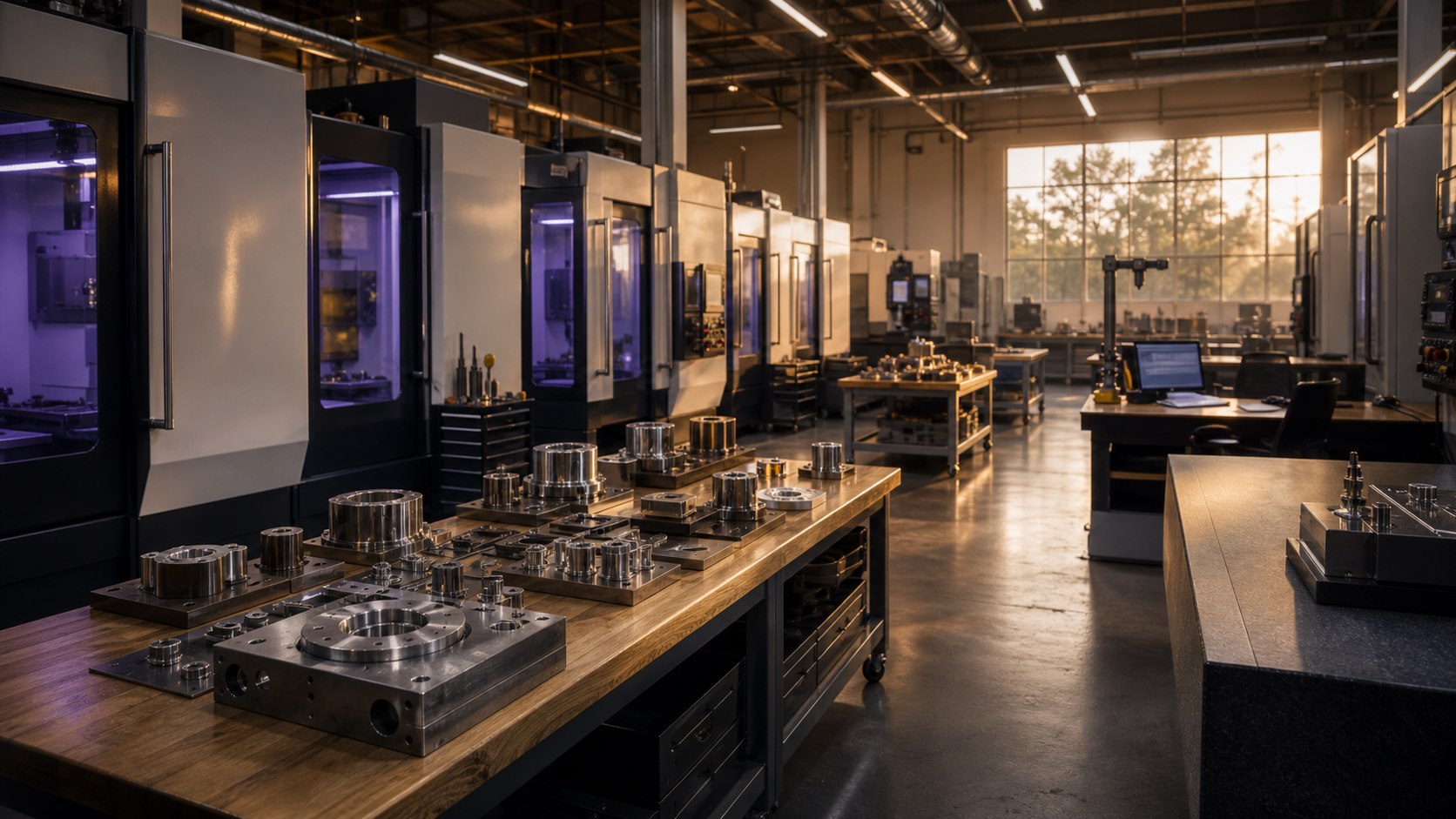
Los Angeles manufacturers and machine shops are hearing the same pressure from every direction: faster turnaround expectations, tighter margins, more documentation, and more follow-up. The good news is that AI is finally becoming useful in the unglamorous spots that actually move the business: reading and organizing documents, drafting first-pass summaries, building checklists, and keeping the office work consistent.
NIST running an AI in Manufacturing workshop (May 27-28, 2026) was a practical signal for operators. The October 2026 update is even clearer: Manufacturing Day attention, NIST MEP manufacturing AI resources, and the 2026 smart manufacturing AI roadmap all point back to the same operating question. Which workflow is ready, who owns the source material, and what should a person approve before AI touches a buyer or production commitment?
Why this NIST workshop matters to LA manufacturers
NIST is not a hype machine. When NIST and the manufacturing ecosystem focus on AI, it usually means there is enough industry interest (and enough real, repeatable value) to warrant coordination. For LA operators, the takeaway is not “AI is mandatory.” The takeaway is “AI is becoming a standard tool for specific manufacturing workflows.”
If you operate in LA County, the pressure often shows up as:
- RFQs arriving by email with messy attachments and missing details.
- Quote preparation that depends on one person’s memory.
- Drawing revision confusion and “which file is final?” chaos.
- Quality notes and inspection docs that are hard to search.
- Customer follow-up that slips when the shop gets busy.
AI helps when it reduces friction in those exact loops.
What the May 2026 NIST AI adoption data adds
NIST MEP's May 2026 manufacturing AI overview puts useful numbers behind what LA shops are feeling. It reports that 46 percent of manufacturers are already using AI tools such as chatbots in operations and that more than 80 percent expect to increase AI use over the next two years. That does not mean every shop needs a factory-wide platform. It means AI literacy, clean data, and workflow training are becoming normal operating requirements.
The same NIST page names the implementation barriers that matter most for small and midsize manufacturers: data quality, cost, workforce readiness, privacy and cybersecurity risk, and older systems that are hard to integrate. Those are exactly the issues a Los Angeles machine shop, fabricator, apparel producer, or industrial supplier has to handle before trusting AI with RFQs, quote notes, quality documents, or customer follow-up.
The practical move is a readiness pass before the software purchase. Start with approved source documents, a safe use-case list, a human review rule, and a short team training plan. NIST's workshop agenda also points toward governed agentic AI and human-AI teaming, which reinforces the same local lesson: make the workflow reliable before asking AI to carry more of it. Sources: NIST MEP manufacturing AI overview and NIST AI for Manufacturing workshop agenda.
What the 2026 roadmap and Manufacturing Day add
NIST's 2026 roadmap for AI and machine learning in smart manufacturing puts structure around the same problem. Smart manufacturing AI depends on data management, trustworthy operation, integration, explainability, reliability, safety, large language models, and foundation models. Those are big topics, but the first local action is small: choose one workflow where the company can control the input, review the output, and measure whether the work improved.
NIST MEP also says Manufacturing Day 2026 began on October 2, with events continuing through the month. For Los Angeles manufacturers, machine shops, fabricators, and industrial suppliers, that makes October a useful checkpoint. A team can use the moment to pick one RFQ, quote-prep, ERP export, document-search, supplier-packet, or customer follow-up workflow and turn it into a 30-day training sprint. The deeper checklist is in B2B LA's Manufacturing Day 2026 AI training guide.
OpenAI's October 2026 GPT-6 model guide adds a model-selection layer to the same decision. Teams should match the model to the workload, test representative tasks, monitor success, and manage cost and latency. For a manufacturer, that means GPT-6 Astra, GPT-6.1 Sol, Claude, Gemini, Copilot, or another tool should be chosen after the workflow is clear, not before.
Don’t start with a big platform. Start with two workflows.
The fastest wins usually come from picking two workflows and making them repeatable. If the workflow does not repeat, it is not a good first AI project. For most LA manufacturers, the first two are:
- RFQ intake → quote prep: extract key requirements, compile questions, and build a consistent quote outline.
- Document search → answers: find the right procedure, tolerance note, material spec, prior quote, or customer requirement quickly.
Once those work, you can expand into scheduling notes, onboarding, customer updates, and other back-office workflows. If the team is ready to automate the repeated handoff, use the B2B LA page for business process automation for Los Angeles manufacturers as the service path.
Use AI for quoting support, not final pricing
AI can accelerate quote prep without letting the model “decide” pricing. The safe pattern is: AI organizes, humans decide. In practice:
- AI drafts a structured quote outline with scope, assumptions, lead time placeholders, and questions.
- AI summarizes drawings and RFQ text into a checklist of requirements to confirm.
- AI generates a short internal “quote packet” summary so the estimator, shop lead, and admin are aligned.
If you want a more detailed view of shop workflows, see AI workflow automation for LA machine shops.
Turn document chaos into searchable knowledge
Many teams think they need AI because they lack information. Usually they have the information, but it is trapped in:
- email threads
- PDF attachments
- folders named “final_v7_revised”
- shared drives with inconsistent naming
The best early AI workflow is a document intake + naming + summary process. That can look like:
- Standard folder structure per customer / RFQ / job.
- Rules for revision naming and “source of truth” location.
- AI-generated summaries attached to the job folder (what changed, what’s required, what questions remain).
AI cannot fix disorganization by itself, but it can make a clean system dramatically more useful.
AI training is what makes the tools stick
Most AI rollouts fail for one reason: the team does not know what “good” looks like. Training is not a one-hour demo. It is a short set of habits:
- What inputs are allowed (and what is not).
- Who reviews outputs and what the review checklist is.
- How to write prompts that match your workflows.
- How to store and reuse templates so the work is consistent.
B2B LA’s AI work is focused on practical workflows and training that matches your team. See AI training for manufacturers and machine shops in Los Angeles.
For shops still choosing the first workflow, source material, and review rule, start with AI consulting for manufacturing companies in Los Angeles. For teams comparing public AI classes with implementation help, the dedicated service page is company-specific AI training for Los Angeles manufacturers and machine shops. It connects RFQ intake, quote-prep checklists, document search, customer follow-up, and human review rules into one training path. For broader AI implementation across construction and manufacturing, use the AI implementation hub.
Don’t ignore back-office automation. That’s where speed comes from.
In manufacturing, “AI” often gets framed as something on the floor. But many of the fastest ROI wins are in the office:
- customer follow-up sequences after RFQs and quotes
- proposal and quote version tracking
- meeting notes and action items
- handoffs between sales, estimating, and production
- basic reporting: what’s stuck, what needs a decision, what’s missing
That is why we pair AI implementation with process cleanup and back-office automation. If you want the “BPO” angle without fake staffing promises, see back-office automation & BPO-style operational support.
A simple AI implementation plan for LA manufacturers
If you want momentum without risk, implement in this order:
- Choose two workflows: RFQ intake/quote prep and document search are usually best.
- Define review rules: who signs off, and what they check.
- Standardize naming: folders, revisions, job IDs, customer names.
- Build templates: prompt templates, checklists, and output formats.
- Train the team: short sessions using real, representative documents.
- Measure: time to quote, time to find a document, follow-up speed, and error rates.
LA neighborhoods and industrial areas where this shows up
In Los Angeles, manufacturing and job-shop work often concentrates in places like Vernon, Commerce, City of Industry, the South Bay, and Long Beach. The workflow problems are similar across all of them: fast-moving RFQs, a lot of attachments, and not enough time to keep the office perfectly organized.
For a focused local training angle, see AI training for Vernon manufacturers, which turns the same AI readiness principles into RFQ intake, quote prep, document search, and review-rule training for local industrial teams.
The point of AI is not to replace decision-makers. It is to keep the work consistent when the phone is ringing and the shop is full.
Manufacturing AI readiness checklist
- Pick two repeatable workflows and define “done.”
- Agree on a naming system for customers, jobs, and revisions.
- Decide what information is allowed in AI tools and what stays internal.
- Create a human review checklist for any customer-facing output.
- Store templates so the work is consistent across the team.
- Track one metric: time-to-quote or time-to-answer a document question.
Manufacturing AI FAQ
What should LA manufacturers do first with AI?
Start with one revenue-close workflow such as RFQ intake, quote-prep notes, document search, customer follow-up, supplier packets, or open-quote reporting. Define source files, allowed data, output format, review owner, and a first-month metric before choosing broader software.
Does NIST guidance mean manufacturers should buy AI software now?
No. NIST manufacturing AI signals point to readiness, data quality, trustworthy operation, training, and integration. A small manufacturer should map one workflow and review rule before buying a platform.
Can AI approve manufacturing quotes?
No. AI can prepare RFQ summaries, missing-information lists, quote notes, customer follow-up drafts, and document-search answers. A qualified person should approve price, lead time, tolerances, substitutions, compliance language, and customer commitments.
How does manufacturing AI training support search visibility?
The same workflow clarity used in AI training can improve public content: capabilities, quoting requirements, service areas, buyer questions, review rules, and useful explanations that search engines and AI answer systems can understand.
Sources reviewed for this update include NIST MEP's Manufacturing Day and manufacturing resources, NIST MEP's manufacturing AI overview, NIST's 2026 smart manufacturing AI roadmap, OpenAI's GPT-6 model guide, Google's generative AI Search guidance, and Manufacturing Dive's reporting on AI and ERP systems.
Want help implementing this in your manufacturing office?
If you run a Los Angeles manufacturing company, machine shop, or industrial service business, reach out to B2B LA. We can map the workflows, build the first templates, train the team, and connect the work to search visibility so buyers can find you.
Reach out to B2B LA